
Silam Sakma - Yakthung Cultural Brand
Origin of Silam Sakma
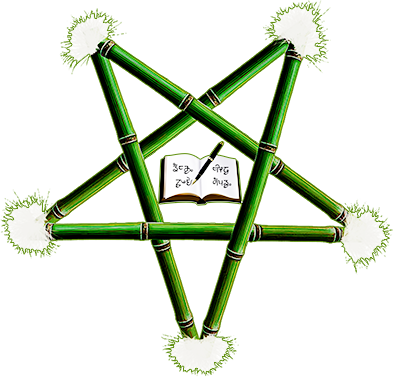
Silam Sakma, a form of handicraft, has been used as a cultural brand of the Limbu community of Nepal and it has also been accepted as a cultural brand internationally. Silam Sakma literally means 'to block the path of death', or 'to preserve life'.
According to Yakthung Mundhum, the process of the formation of the Earth started with the formation of the universe. In the beginning, the Earth was covered with water, with no dry ground. Then, Ijumimang Idakamang (spider) spans its web from east to west, and from north to south. Many things got stuck to the loops of the spider's web and land was formed. Once the land was formed, Tagera Ningwabhuma created many living beings. Based on this web, Yeba Samba Phedangma created Silam Sakma.
In another myth about the origin of Silam Sakma, an epidemic broke out in the village of Sawa Yehang and many die from the illness. People continued to die one by one for years, and many thought that the human race would be destroyed. So, they requested Sodhungen Lepmuhang to end the epidemic. Sodhungen Lepmuhang sent Phedangma, Samba, Yeba, and Yema to the village of Sawa Yehang. To stop the epidemic, phedangma, Samba, Yeba, and Yema curled the ends of the two ghungring sticks and pulled out the fiber from the ends of the sticks. They made the Silam Sakma by sticking a ghungring stick vertically into the middle part and tied it with a thread and made nine rounds.
The Yakthung ancestors went to the homes of Sawa Yethang, the Phedangma, Samba, Yeba, and Yema, and fixed the Silam Sakma above their hearths, right on the sarang, while reciting the Mundhum. After they did this, the number of deaths dropped, and the epidemic stopped. Ever since, the Phedangma, Samba, Yeba, and Yema have relied on Silam Sakma to keep people safe and prevent epidemic.
There’s another story about how humans came to be. Tagera Ningwaphuma Yumamang told Porokmi Yamphamimang to create humans, since the universe felt incomplete without them. So Porokmi Yamphamimang went ahead and created people out of gold, silver, and diamonds. But when he called out to them, they stayed silent.
He went back to Tagera Ningwaphuma Yumamang, asking for guidance. This time, he was told to use earth, ashes, and even bird droppings. And that worked! The new humans came to life, and when called, they answered.
Porokmi Yamphamimang was disappointed with the ones made from precious metals, so he spat on them for not speaking, and the person nearly died. But, to pull this person back from the death, Porokmi Yamphamimang followed Tagera Ningwaphuma Yumamang’s instructions and used Silam Sakma to save their life. That’s how Silam Sakma turned into a symbol for preserving life.
Use of Silam Sakma
Silam Sakma has been a big part of rituals led by Phedangma, Samba, Yeba, and Yema. They use it during ceremonies like Tangsing, Lambhoba, Tingding Nahen Mikso, Sakmura Khenga whenever they’re calling or protecting the soul, and preventing misfortune. It’s made from raw white thread, specifically for these rituals.
Limbu organizations started using Silam Sakma as their logo since 2046 B.S. By 2058 B.S., big, colourful versions started appearing, and by 2064 B.S., people began wearing it as jewellery. Some have also crafted it from gold, silver, or brass. People started giving it as gifts, tokens of love, or as a sign of hospitality. You’ll often find Silam Sakma on display in Limbu homes.
Lately, Silam Sakma designs have been used on clothes made from Dhaka fabric. Metallic statues of silam sakma have also appeared in Limbu neighbourhoods, squares, parks, and tourist spots. At present, even non-Limbus have started wearing or displaying silam sakma. From the streets to the parliament, from the hut to the palace, everyone is wearing it.
Silam Sakma, a form of handicraft, has been used as a cultural brand of the Limbu community of Nepal and it has also been accepted as a cultural brand internationally. Silam Sakma literally means 'to block the path of death', or 'to preserve life'.
According to Yakthung Mundhum, the process of the formation of the Earth started with the formation of the universe. In the beginning, the Earth was covered with water, with no dry ground. Then, Ijumimang Idakamang (spider) spans its web from east to west, and from north to south. Many things got stuck to the loops of the spider's web and land was formed. Once the land was formed, Tagera Ningwabhuma created many living beings. Based on this web, Yeba Samba Phedangma created Silam Sakma.
In another myth about the origin of Silam Sakma, an epidemic broke out in the village of Sawa Yehang and many die from the illness. People continued to die one by one for years, and many thought that the human race would be destroyed. So, they requested Sodhungen Lepmuhang to end the epidemic. Sodhungen Lepmuhang sent Phedangma, Samba, Yeba, and Yema to the village of Sawa Yehang. To stop the epidemic, phedangma, Samba, Yeba, and Yema curled the ends of the two ghungring sticks and pulled out the fiber from the ends of the sticks. They made the Silam Sakma by sticking a ghungring stick vertically into the middle part and tied it with a thread and made nine rounds.
Porokmi Yamphamimang was disappointed with the ones made from precious metals, so he spat on them for not speaking, and the person nearly died. But, to pull this person back from the death, Porokmi Yamphamimang followed Tagera Ningwaphuma Yumamang’s instructions and used Silam Sakma to save their life. That’s how Silam Sakma turned into a symbol for preserving life.
Use of Silam Sakma
Silam Sakma has been a big part of rituals led by Phedangma, Samba, Yeba, and Yema. They use it during ceremonies like Tangsing, Lambhoba, Tingding Nahen Mikso, Sakmura Khenga whenever they’re calling or protecting the soul, and preventing misfortune. It’s made from raw white thread, specifically for these rituals.